Ace Insurance in Modern Blackjack: Exploring Intersections with Splits, Doubles, and Alternative Payout Structures
Written by Zara Foster · Aug 19, 2026

Ace Insurance in Modern Blackjack: Exploring Intersections with Splits, Doubles, and Alternative Payout Structures
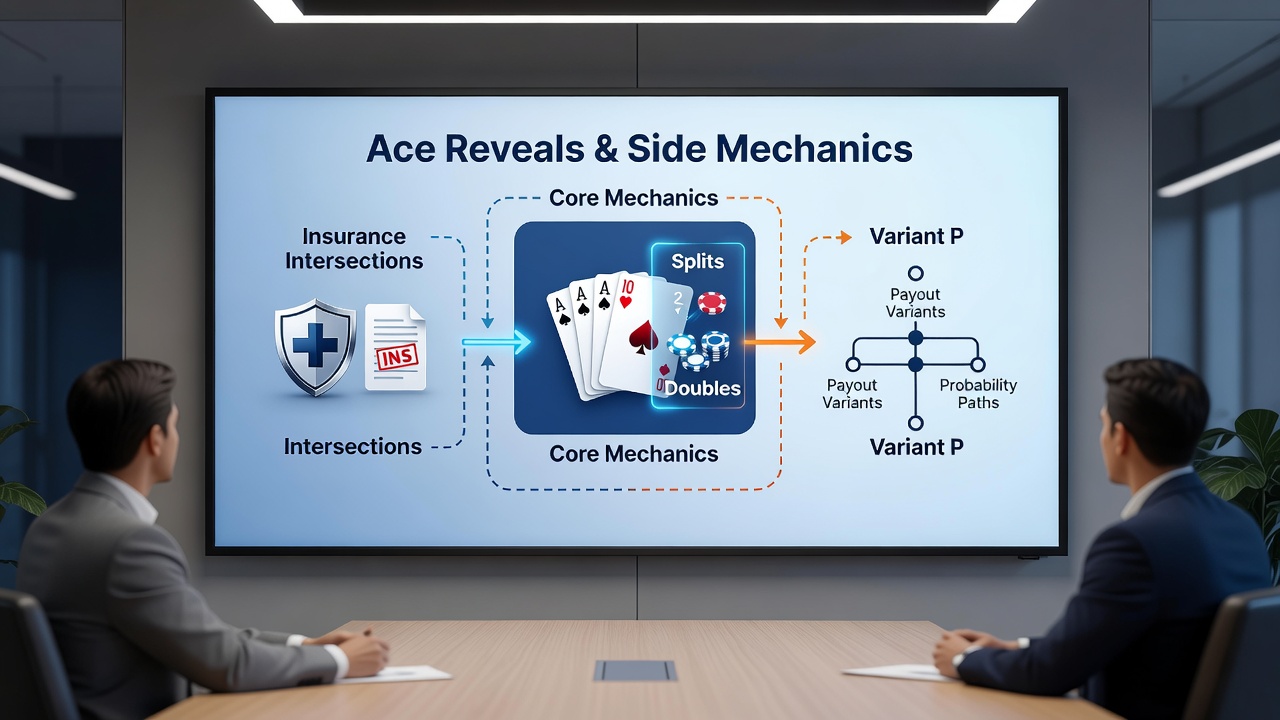
Insurance mechanics in blackjack operate as a side wager that activates when the dealer reveals an ace as the upcard, allowing players to bet up to half their original wager at 2:1 odds against the dealer holding a ten-value card in the hole. This structure creates layered decisions once splits and doubles enter the equation, because each new hand generated through splitting inherits its own insurance eligibility in most rule sets while double downs typically lock in after the initial insurance window closes.
Core Insurance Triggers and Ace Reveal Protocols
Dealers follow standardized reveal procedures where the ace upcard prompts an immediate insurance offer before any player actions beyond the initial deal occur. Data from the Nevada Gaming Control Board shows that insurance participation rates hover near 15 percent across monitored tables, with higher uptake when players hold strong totals like 19 or 20. Yet the presence of multiple aces on the table can shift probabilities, since variant payout grids sometimes adjust insurance odds or cap side-bet exposure in games that pay blackjack at 6:5 instead of the traditional 3:2.
Splits and the Multiplication of Insurance Opportunities
When a player splits a pair, each resulting hand stands as an independent wager subject to its own insurance check if the dealer still shows an ace. This multiplication effect means a single insurance opportunity can expand to cover two or more hands, although some casinos require separate insurance bets per split hand while others permit one insurance wager scaled to the total exposure. Observers note that rule variations in Australian casinos, governed by state-level authorities such as the Queensland Office of Liquor and Gaming Regulation, often restrict insurance on split hands to the first hand only, reducing the effective payout grid complexity.
Double downs introduce further constraints because the insurance decision must precede the double action. Once a player doubles, no additional insurance can be placed on that hand, locking the risk profile even if the dealer later confirms a blackjack. Research published through the University of Nevada, Las Vegas Center for Gaming Research indicates that players who combine insurance with early doubles experience a measurable increase in variance, particularly when payout grids incorporate progressive side bets tied to ace reveals.
Variant Payout Grids and Regional Adjustments
Payout grids diverge sharply across jurisdictions. In Singapore, the Casino Regulatory Authority oversees tables where insurance pays at standard 2:1 yet certain side bets tied to ace totals alter the overall return when splits occur. European venues regulated by the Malta Gaming Authority frequently eliminate insurance altogether in favor of "no hole card" rules, forcing players to navigate splits and doubles without the protective side wager. These structural differences create distinct strategy matrices that players must recalibrate when moving between markets.
August 2026 brought new reporting requirements from the New Jersey Division of Gaming Enforcement that mandate clearer disclosure of how insurance intersects with multi-hand scenarios. The updated guidelines require casinos to publish simplified charts showing payout outcomes for insured split hands under both 3:2 and 6:5 blackjack structures, aiming to reduce player confusion around variant grids.
Strategic Intersections and Probability Shifts
Basic strategy charts expand when insurance, splits, and doubles interact. For instance, a player holding a pair of eights against a dealer ace may split, then face separate insurance decisions on each hand depending on house rules. Data indicates that the expected value of insuring one split hand but not the other rarely justifies the action, yet many automated table systems now prompt for each decision individually. Those who study these intersections often discover that variant payout grids favoring the house on blackjack also compress insurance profitability, making the side bet less attractive overall.
Additional layers appear in games featuring ace-specific side bets, where an insured hand might simultaneously qualify for a bonus payout if subsequent cards produce particular combinations. Such overlaps require careful tracking because the insurance bet settles immediately upon dealer reveal while the side bet resolves at the end of the round.
Conclusion
Insurance mechanics in blackjack remain tightly coupled to split and double decisions through shared timing windows and multiplied hand structures. Variant payout grids further modulate these relationships across regulatory regions, with ongoing updates such as those issued in August 2026 continuing to shape how operators present and settle these intersecting options. Players navigating these systems benefit from understanding the precise rule set in use, because small differences in insurance eligibility after splits or alongside doubles produce measurable shifts in overall return profiles.